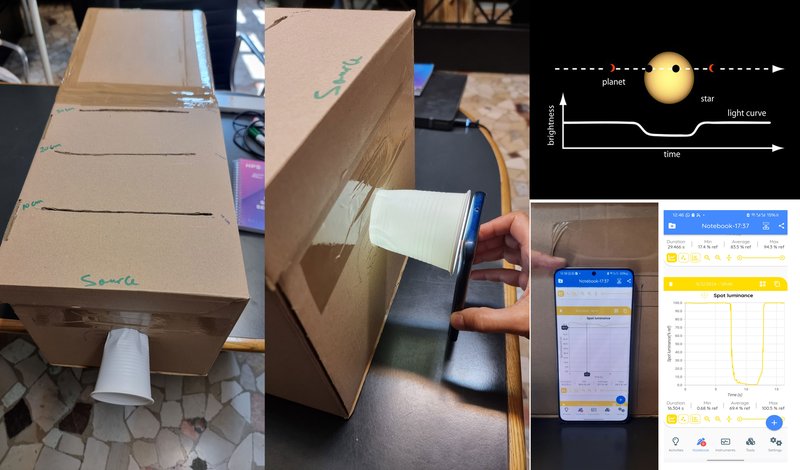
This activity introduces students to exoplanet detection using the transit method. Through hands-on activities, students will simulate an exoplanet transit using basic materials, measuring changes in light intensity as the “exoplanet” passes in front of the “star.” Students will model transit events, experimenting with different parameters of the exoplanets. Students will compare their models and findings with those of their peers and general properties of exoplanetary systems, enhancing their ability to communicate scientific concepts and results effectively. The workshop emphasizes inquiry-based learning, allowing students to design experiments, apply mathematical reasoning, and analyze data using the scientific method.
NOTE: This activity was proposed by NAEC Team Morocco within the Sabir co-design project developed by the OAE Center Italy (Milan, 2-6 September 2024). For more information : link to OAE Center Italy webpage dedicated to the project.
NOTE: This activity was proposed by NAEC Team Morocco within the Sabir co-design project developed by the OAE Center Italy (Milan, 2-6 September 2024). For more information : link to OAE Center Italy webpage dedicated to the project.
Resource Link
Activity Information
Big Ideas

We may not be alone in the Universe
Source: AstroEdu – International Astronomical Union