
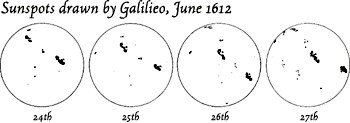
The Earth rotates on its axis, giving us night and day – but what about other celestial objects like the Sun? In this activity students will use real satellite images of the Sun (Solar Dynamics Observatory, SDO) to discover that the Sun also rotates about its own axis! For this they will use a technique used for the first time by Galileo Galilei himself, and still used by astronomers to this day: following the displacement of sunspots. Observing Galileo’s drawings, students will make hypotheses about the nature and motion of sunspots. To test their hypotheses and provide evidence for the rotation of the Sun, they will use a set of 27 consecutive daily SDO images from the 25th November to the 20th December 2014, containing a large number of sunspots. Students will make crude estimates of the rotation period of the Sun (without calculations) by following different sunspots. They will finally discuss and compare their findings.
This activity is part of the GalileoMobile Handbook of activities and was tested during our expeditions in India and Uganda.
Resource Link
Activity Information
Big Ideas
We are all made of stardust
Source: AstroEdu – International Astronomical Union